Melt package of candy coating in a small pot on low heat – stirring constantly until all melted. Pour over a baking sheet lined with parchment paper.: The moment the coating warms, the kitchen fills with a sweet, vanilla aroma that signals the start of the magic. As you stir slowly, notice the glossy sheen develop and the way the mixture becomes viscous yet pourable, that is your cue to remove from heat. Constant stirring prevents hot spots which can scorch the coating and create grainy lumps, so use a gentle wrist motion and a heatproof spatula. A common error is turning the heat up to speed things along, which risks separation and a dull texture. If the coating seems too thick, a tiny splash of neutral oil can loosen it, but add sparingly to avoid greasy finish.
Sprinkle on crushed oreos, M&Ms and sprinkles.: When you pour the melted coating, do it in a slow, steady stream from the pot, watching it spread into a glossy canvas on the parchment. The sound is almost inaudible, but you can see the liquid settle and level itself, offering a smooth working surface. Pour toward the center and use the back of a spatula to gently coax the coating into even thickness, keeping the edges neat. Trying to overwork it while it is cooling can create streaks or thin spots, so aim for one smooth pass. If bubbles appear, tap the tray lightly on the counter to bring them to the surface.
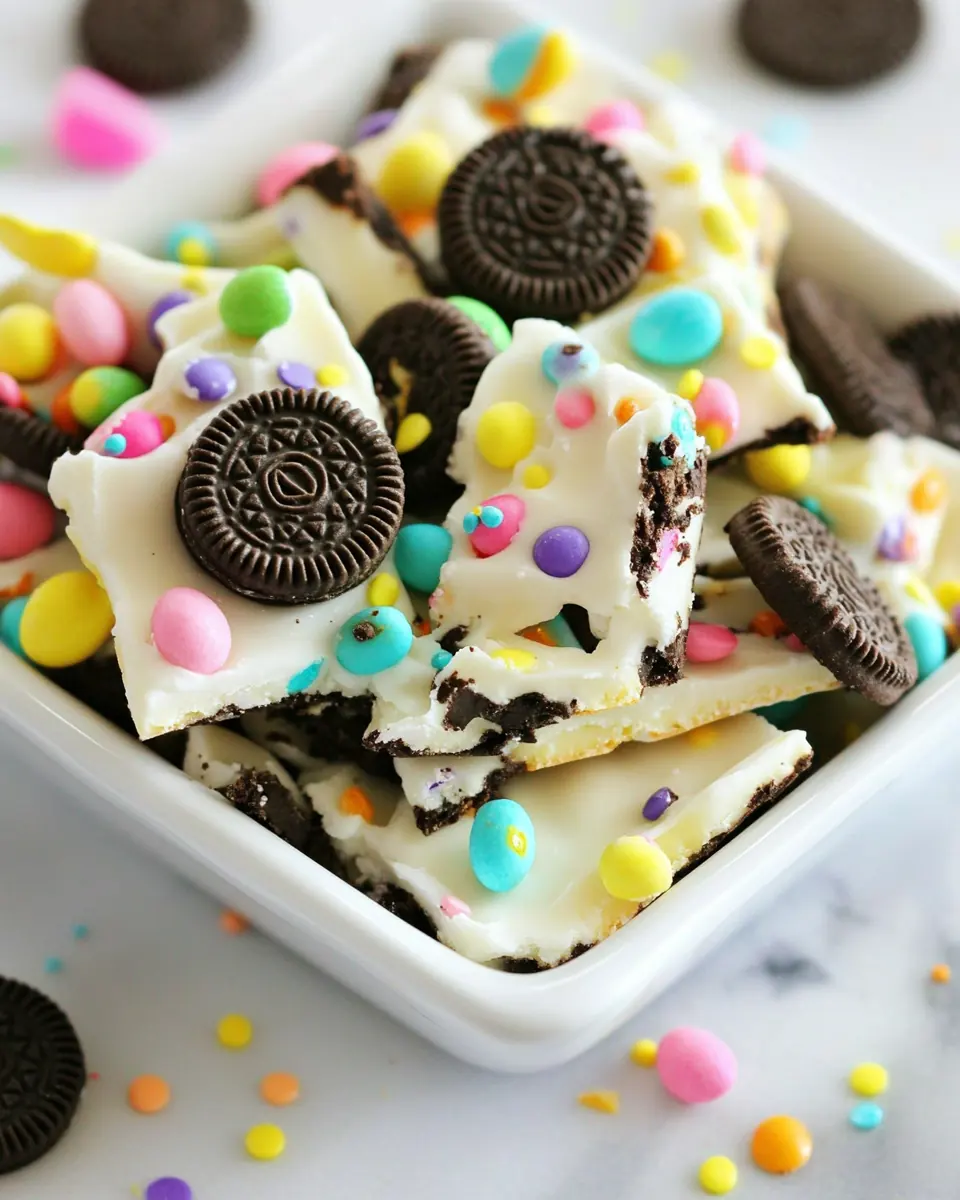
Place in fridge for half hour-hour.: As soon as the coating is poured, sprinkle the 3/4 cup Easter Spring Oreos crushed , 3/4 cup M&Ms Easter , and Spring or Easter sprinkles over the surface, focusing on even distribution so each piece gets a mix. The contrast of colors against the pale coating makes the piece pop visually, and pressing a few candies gently into the surface helps them adhere as it sets. You will feel a tiny crunch under your fingertips when you press, and that tactile feedback is satisfying. Avoid waiting too long to add the toppings, because if the coating firms they will not stick and may slide off when you break the bark.
Break into pieces: Cooling is where the bark gains structure, and you will notice the gloss dull slightly as the coating firms. The fridge provides consistent coolness which yields a neat, snapable texture. Set the tray on a level shelf and leave undisturbed for the recommended time, checking once at the shortest mark so you do not overchill and risk condensation. A troubleshooting tip is if condensation forms when you take the tray out, let it sit for a few minutes before breaking, to avoid sticky pieces. Too short a chill leaves a soft, bendable bark that is hard to break cleanly.
Break into pieces: Once fully set, lift the parchment and give it a gentle flex to coax the bark to crack, then break into irregular pieces for a rustic look. You will hear satisfying snaps as shards separate, and the exposed cross sections show off the embedded candies and cookie fragments. Use a knife if you want more uniformity, but I usually hand break to keep the charming, uneven shapes. A common mistake is trying to cut when the bark is still slightly warm, which causes smearing and uneven edges, so ensure it is completely chilled for the cleanest pieces.