Line a baking sheet with parchment paper and spray with cooking spray.: The moment you spread the finished mixture onto the prepared sheet you want it to release cleanly when cool, so the parchment paper and a light coating of spray prevent sticking. You will notice the sheet is smooth and ready, and the sound of the spray is nearly silent. If you skip this, the mixture can bond to the pan and break irregularly when you try to lift it. A common error is using wax paper instead of parchment, which may melt under heat, so always choose the right liner. Preparing this ahead keeps your workflow seamless because the sticky mixture needs an immediate place to go. If your pan is not level, the mixture may pool on one side, so set it on a flat surface.
In a very large bowl, add the Chex and Grahams cereal, coconut, and almonds and stir together.: When you combine the Chex cereal , Golden Grahams cereal , shredded coconut , and sliced almonds the aroma is dry and nutty, and you can already sense the contrasting textures. Stir gently to blend without crushing the cereals, the sound will be a light rustle as the pieces tumble together. The reason for using a very large bowl is to have room to fold in the syrup without spillage. One slip up is adding the syrup to a bowl that is too small, causing overflow and wasted mixture. Keep the bowl at arm's length from your syrup so you can pour and stir with control. Visually, you want a uniform distribution of the ingredients so each bite has a little of everything.
Microwave version: In a large microwave safe bowl, add the butter, sugar, and corn syrup. Microwave for 5 minutes stirring halfway. Remove and stir well. Microwave for 2 more minutes. Remove from heat and add the vanilla and baking soda. Stovetop version: In a large saucepan, bring the butter, sugar, and corn syrup to a boil then start the timer and cook for 4 1/2 minutes at a boil. Remove from the heat and stir in the baking soda and vanilla.: In a large microwave safe bowl, add the butter, sugar, and corn syrup. Microwave for 5 minutes stirring halfway. Remove and stir well. Microwave for 2 more minutes. Remove from heat and add the vanilla and baking soda. Stovetop version: In a large saucepan, bring the butter, sugar, and corn syrup to a boil then start the timer and cook for 4 1/2 minutes at a boil. Remove from the heat and stir in the baking soda and vanilla : The sauce is where patience pays off. On the microwave path you will see the butter melt and the sugar dissolve, creating a glossy, amber blend, and stirring halfway prevents hot spots. When you remove it to add the vanilla extract and baking soda , the mixture will foam slightly because of the baking soda reacting, that foamy expansion is normal and desirable as it lightens the syrup. On the stovetop the bubbling becomes more vigorous, and a gentle rolling boil for the suggested time produces the correct viscosity, the sound will be a steady simmer that grows into a soft, energetic bubble. The reason to remove immediately and stir in the baking soda is that residual heat will continue to cook the sugar, and premature addition can lead to uneven texture. A frequent mistake is undercooking the sugar, which yields a runny coating, or overcooking, which makes it too brittle. Watch the color, aiming for a medium golden tone rather than deep amber, because darker sugars taste more caramelized and can overpower the other flavors.
Immediately pour the sugar mixture over the cereal mixture and stir until very well combined. Spread onto the prepared baking dish and let cool. Break into pieces and enjoy.: When you tip the warm, glossy syrup onto the dry mix, you will hear a soft hiss as moisture meets crunch, and steam rises with a sweet, toasty scent. Stirring quickly but gently encourages even coverage, and you should see every piece glisten as it becomes coated. The reason for this immediacy is that the syrup thickens as it cools, and delayed mixing can cause clumping or uneven coating. One troubleshooting tip is to fold from the bottom up, using a spatula to bring uncoated pieces into the syrup rather than beating aggressively which crushes the cereal. If you notice any pockets of dry cereal, interrupt your stirring and fold them in right away. The ideal final appearance is a uniformly coated mixture that still shows the shapes of the cereals and nuts, not a homogeneous paste.
Spread onto the prepared baking dish and let cool: As soon as the mix is combined, spreading it evenly on the parchment lined sheet helps it set into pieces that are easy to break apart when cool. Use an offset spatula or the back of a spoon to create an even layer; you should hear a faint dragging sound as the mixture settles. Cooling allows the syrup to firm to the right chewiness, and the surface will lose its sheen and become set to the touch. A common pitfall is trying to break the mix while it is still warm, which leads to sticky clumps rather than clean pieces. Let it sit at room temperature until it is completely cool, which preserves the texture contrast between the crisp cereal and the set syrup. Once set, you can break it into pieces of your desired size and the pieces should snap cleanly rather than bend.
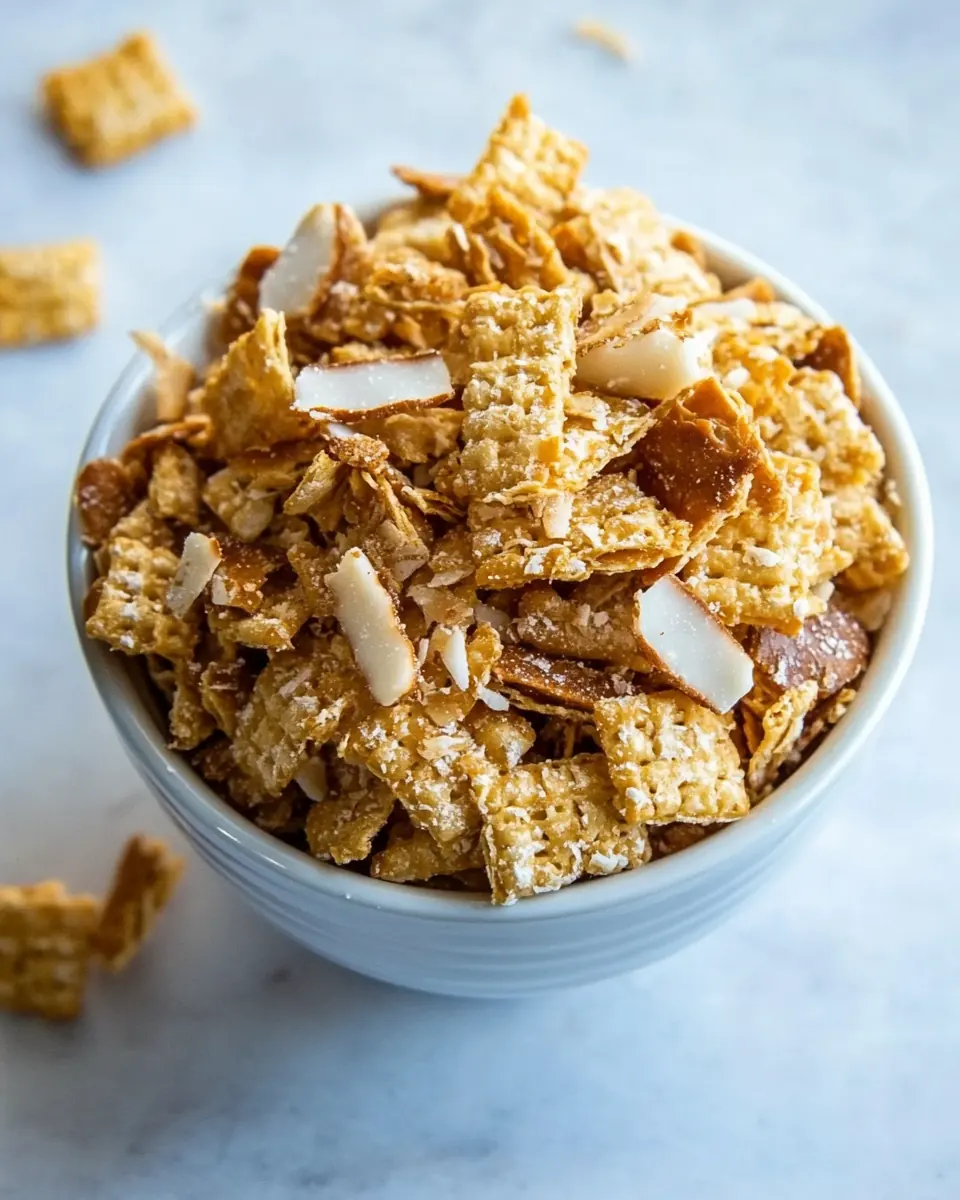
Break into pieces and enjoy: The final step is pure reward. The sound of breaking the set tray is a satisfying snap with a hint of crunch. The first bite should offer a layered sensory experience: the cool, set syrup yielding to airy Chex cereal , the honeyed crunch of Golden Grahams cereal , the chew of coconut , and the nutty bite from sliced almonds . If any pieces seem overly sticky, they likely needed more cooling time. Store in an airtight container once cooled to keep the texture consistent, because exposure to humidity softens the cereal. Enjoy it with a cup of coffee or share it at your next gathering.