Cut gelatin sheets into 1-inch strips and submerge in cool water for at least 5 minutes to soften.: The gelatin will feel flexible as it hydrates, and the water will become slightly cloudy, but that is expected. Softening the sheets gently rather than using hot water preserves their setting strength, which is why we hydrate first. A common mistake is leaving sheets too long, which can make them gummy and harder to squeeze out later, so watch the clock and keep the temperature cool.
Combine lemon juice, zest, and sugar in a small saucepan. Bring to a simmer over medium heat.: As the mixture warms you will smell the floral citrus aroma lifting into the air, and tiny bubbles will begin to form around the pan edges, indicating the right simmering stage. Heating slowly prevents the sugar from burning and helps extract the volatile oils from the Meyer lemon zest, which deepen the flavor. Avoid boiling vigorously, which can make the curd grainy.
Whisk cornstarch with 1 tablespoon water. Add to saucepan and return to heat, bring to a simmer and let bubble, stirring occasionally, for about 1 minute or until thickened.: Once the slurry hits the warm lemon, you will notice the liquid glossy and slightly thicker, clinging to the whisk. This is the texture you want for a stable curd base. Stirring prevents lumps and ensures even thickening, a frequent pitfall if the slurry is added too quickly.
Wring out softened gelatin with your hands, squeezing out as much water as you can (for powdered gelatin, just add it straight to the pan, liquid and all). Add to saucepan with warm lemon mixture and whisk until completely dissolved.: When the gelatin dissolves, the mixture will become silkier and slightly more viscous, and any tiny particles will disappear. Fully dissolving the gelatin is critical to avoid soft pockets that won’t set later. If you do not fully squeeze out the water, the curd can become too diluted and take longer to set.
Remove from heat and whisk in butter until smooth. If you want a brighter yellow color, add a bit of yellow food coloring if desired.: As the butter melts into the warm curd, it will give the mixture a glossy sheen and a rounder mouthfeel. The butter should be added off heat to avoid separating; whisking makes the emulsion stable. Overheating after adding butter can cause the fat to separate, creating an oily surface.
Pour into 1-inch silicone sphere molds. Freeze overnight until completely set, then gently remove from molds (they will not be frozen solid; if you have a hard time getting them out of the molds, try using a small espresso spoon to 'scoop' out the curd, retaining the dome shape as much as possible).: When semi frozen the curd will be firm to the touch but still yield slightly, holding a dome. Using silicone molds makes unmolding easier, and a chilled dome holds shape within the mousse. Forcing a too-soft curd out too early will break the dome, so freeze until it keeps its form.
Preheat oven to 300 degrees F. Line a sheet pan with parchment paper. Using a cookie cutter that is the exact size of your dome molds (2 1/2-inches for me), trace twelve evenly-spaced circles onto the parchment. You'll use these circles as a guide for piping the dacquoise.: The gentle oven temperature dries the meringue slowly, resulting in a tender interior with a crisp shell. Tracing circles ensures uniform rounds that match the dome size. If you skip marking the circles your piped rounds can vary in size and not fit the molds properly.
In a food processor, pulse pistachios a few times to break them up. Add pistachio or almond flour and powdered sugar, and pulse a few more times until finely ground. You can use all whole pistachios if you want (100 g total).: Pulse just until finely ground to avoid releasing too much oil from the nuts, which would make the mixture greasy. The pale green flecks of pistachio and the dusting of powdered sugar create a tender, flavorful nut base for the meringue. Over processing will turn the nuts into a paste that will weigh down the meringue.
Place egg whites in a mixing bowl (save the leftover yolks, you'll use them in the mousse layer). Whip on medium speed until frothy. With the mixer running, slowly spoon in sugar, a tablespoon at a time. When all the sugar has been added, increase speed to high and beat until whites are thick and glossy and hold medium-stiff peaks.: You will see the whisk leave soft ribbons in the whites as they become glossy and form peaks that hold their shape. This glossy meringue is the structure for the dacquoise. Adding sugar slowly stabilizes the protein network; dumping it in all at once can deflate the whites.
Fold half of ground pistachio mixture into whites to lighten, then add remaining pistachios, folding until just incorporated.: Folding gently preserves the air you just whipped into the egg whites , and the ground nut mixture should be visible as a uniform speckling. Overmixing will collapse the foam and yield dense rounds, so fold until you no longer see streaks.
Transfer to a piping bag fitted with a 1/2-inch round piping tip. Pipe circles just inside the circles you drew on the parchment.: As you pipe, listen for a soft hiss of batter flowing, and watch the rings fill the traced guides evenly; they should not spread far beyond the lines. Consistent pressure produces uniform rounds. If your piping is uneven you will have rounds that bake inconsistently.
Sprinkle tops of piped dacquoise with chopped pistachios if desired, then dust lightly with powdered sugar.: The chopped pistachios will settle into the surface and toast slightly in the oven, adding crunchy texture and a roasted aroma. A light dust of powdered sugar keeps the top from looking too dry and adds a delicate finish. Heavy dusting can mask the nut color and melt into the surface.
Bake for 8 minutes or until the tops of the cookies are just set but still soft. Remove from oven and use a round cookie cutter (one size larger than you used to trace the circles) to 'swirl' around the edges of the soft meringue until you can see the edge of the pencil marks. Do this quickly while they are still hot and pliable. If your cookies are already too crisp to reshape, you can use the exact size cookie cutter to cut off the edges to make your rounds the size they need to be. Note that if you do this the cookies will deflate and will be quite a bit flatter in the end.: When the meringues are set yet flexible they will hold shape when swirled; this creates neat edges that match the dome circumference. Working while hot is key because the meringue firms as it cools. If you wait until they are crisp they will crack when reshaped, resulting in irregular rounds.
Return pan to oven and bake for another 25 to 35 minutes more, or until tops are crispy and ever so lightly browned. Thicker rounds may need up to 40 minutes to completely dry out. Turn off oven, crack the oven door and let the cookies cool down in the warm oven which will help them dry out even further.: The slow drying process produces a crisp exterior and a tender interior; you may detect a faint toasted aroma as sugars caramelize slightly. Letting them cool in the warm oven prevents a sudden temperature shift that could cause cracking. Removing them too early can leave them sticky and prone to collapse.
Cut gelatin into 1-inch strips and submerge in cool water to soften.: Repeating this step for the mousse ensures the sheets are ready to dissolve in the warmed custard. Proper softening ensures a smooth mousse once the gelatin is incorporated. Forgetting to soften will mean the gelatin may clump when added to warm liquid.
In a bowl, whisk together egg yolks and granulated sugar until lightened.: The yolk mixture will turn paler and slightly thickened, a sign that it has incorporated air and sugar. This step helps stabilize the custard base for the mousse and prevents curdling when warm dairy is added. Under-whisked yolks can scramble when tempered with hot liquid.
Warm cream, milk, vanilla, and lemon zest in a saucepan over medium heat until it starts to steam. Slowly ladle into egg yolks, whisking constantly, until most of cream has been incorporated and mixture is warmed through. Return to saucepan and cook over low heat, stirring frequently, until it thickens and coats the back of the spoon (will measure 165 degrees F on an instant read thermometer).: The steam and aroma of Meyer lemon and vanilla will infuse the dairy, and the custard will become noticeably thicker and ribbon when you lift the spoon. Cooking low and slow is crucial to prevent curdling while achieving a safe, thickened custard. Overheating will scramble the yolks making the texture grainy.
Wring out water from softened gelatin and add to warm custard; whisk until smooth. Run through a fine mesh sieve to remove zest and any solid bits; let cool for at least 15 minutes until lukewarm.: The custard will become silkier after gelatin dissolves, and sieving removes any residual strings of zest for a clean mousse texture. Cooling to lukewarm before folding in whipped cream prevents the cream from melting and keeps the mousse airy. Folding in while too warm will deflate the whipped cream.
In a clean bowl or the bowl of a stand mixer, beat heavy cream until it holds soft peaks (do not over-beat). Add 1/3 of whipped cream to the cooled custard and fold to lighten, then add the remaining cream and fold until fully incorporated.: The whipped heavy cream should be pillowy and just hold its shape; when folded into the custard it lightens the mixture and creates volume. Use gentle strokes to preserve the air. Over-whipping the cream into grainy butter will ruin the mousse's silky texture.
To assemble your cakes, spoon or pipe the mousse into 2 1/2-inch silicone dome molds, not quite all the way full. Gently press a lemon dome, curved side down, into the top of each mousse-filled mold. If you find your lemon domes are sinking, let the mousse chill in the molds for 15 minutes or so to firm it up just a tiny bit.: The mousse should feel cool and creamy when handled, and the lemon dome will create a concentrated burst of acid at the center. Pressing the dome curved side down keeps the lemon concentrated near the top of the cake where it will be revealed when sliced. If the mousse is too loose the dome will sink, so chilling briefly can prevent that.
Finally, top with round of pistachio dacquoise, pressing lightly just until the mousse starts to pop out the sides. Place on a flat cookie sheet and place in the freezer so it is level; freeze for at least 3 hours or overnight until set solid.: When assembled, the cakes should be level and stable in the freezer; you may hear a faint freeze hiss as moisture crystallizes. Freezing solid is essential before glazing so the mirror coat sets quickly on contact. Rushing the freeze step will result in glaze that soaks in instead of coating cleanly.
Before you make the glaze, remove cakes from molds and invert (dacquoise side down) on a frozen cookie sheet lined with parchment paper. Return to freezer until just before glazing.: Inverting makes glazing easier and shows off the glazed dome once finished. Keep them frozen until glazing to ensure the hot glaze forms a thin shell immediately. If they are not sufficiently frozen the glaze can soften the mousse and distort the shape.
Cut gelatin into 1-inch strips and submerge in cool water for at least 5 minutes to soften. Place white chocolate in a heat-proof bowl and set aside.: Preparing the gelatin and chocolate early speeds the glaze process; the white chocolate should be finely chopped to ensure fast, even melting when the hot syrup is added. Failing to chop finely can leave unmelted chunks in the glaze.
Combine sugar, corn syrup, and water in a saucepan and bring to a boil over medium heat until sugar is completely dissolved and mixture is clear.: The syrup will become glossy and transparent, and you should see no sugar crystals at the pan edges. This clear syrup is the base for the glaze; ensure full dissolution to avoid graininess. Boiling too hard can darken the syrup and change the flavor.
Remove from heat, then add gelatin (squeeze out as much water as possible first) and whisk until dissolved. Whisk in sweetened condensed milk. Pour hot mixture over chopped white chocolate and let sit for 30 seconds, then stir until chocolate is completely melted and mixture is smooth (you can also use an immersion blender if you have one to expedite this process, just try not to mix air bubbles into the glaze if possible).: After adding gelatin and condensed milk the mixture will thicken and become luxuriously glossy. Pouring it over the chocolate allows gentle melting without overheating the chocolate, which preserves its texture. Blending can help smooth any tiny lumps but too much air will create bubbles in the finished glaze.
Add powder or gel food coloring as desired. You can also divide your glaze up into multiple colors and then swirl them if you'd like.: Color will dramatically affect presentation, and gel colors work best because they do not overly thin the glaze. If you plan to swirl multiple colors, work quickly while the glaze is fluid to maintain marbling. Waiting too long will yield muted lines because the glaze thickens as it cools.
Let glaze cool, stirring occasionally, until glaze reaches approximately 85 to 90 degrees F on an instant-read thermometer. The glaze needs to be the correct temperature: too warm and it will not form a thick enough layer on the outside of the cakes; too cool and it will not flow smoothly.: The temperature window is crucial, as it governs the glaze's viscosity and sheen; at the target temperature it will coat evenly and set with a beautiful mirror. If it is off by much the glaze can either run off too quickly or fail to cover smoothly.
Remove cakes from freezer and place on a cookie sheet, elevated off the sheet using small jars or cookie cutters (ideally something smaller in diameter than the cake itself so the glaze can drip off). You can also put them on a wire rack. If you have more than 6 or 8 individual cakes, I recommend working in two batches. You can always rewarm the glaze if it gets too cool (do so gently over a double boiler or in very short intervals in the microwave).: Elevating each cake allows the glaze to drip freely and form an even coat. Working in small batches prevents the glaze from cooling too much before you finish a set. A common error is trying to glaze too many cakes at once, which results in cooled, uneven glaze.
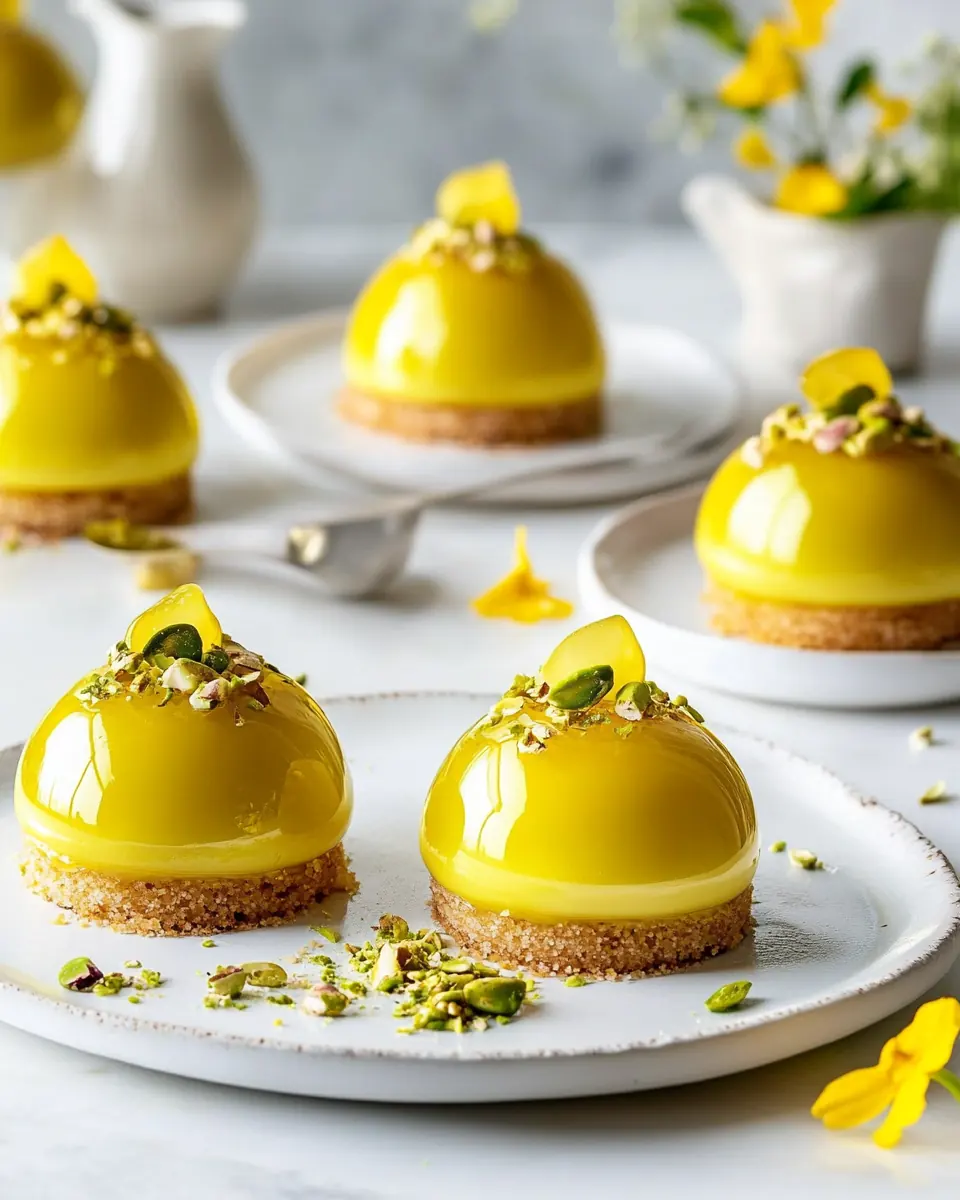
Pour glaze generously over cakes, taking care to ensure there are no bare spots left. Allow the excess glaze to drip off for 5 or 10 minutes, then gently scrape the edges to remove any remaining drops. Carefully transfer cakes using a small offset spatula to cardboard cake rounds or small pieces of parchment paper for easy movement. Any leftover glaze can be scraped up and refrigerated in an airtight container for later use.: As you pour, watch the glaze flow and listen for the soft whisper of liquid hitting the chilled domes, then watch it settle into a continuous reflective layer. Allowing excess to drip ensures a uniform coat; scraping too aggressively can break the glaze film. If glaze firms too much, gently rewarm before touching it again.
Use a small spoon to coat the bottom edges with chopped pistachios, tapping off excess. Garnish with a lemon twist, if desired.: The chopped pistachios will adhere to the warm glaze edges and add a crisp, nutty border. A thin lemon twist provides aromatic brightness and a visual cue to the flavor inside. Don’t overload the edges with nuts or you will hide the glossy finish.
Glazed cakes will keep in the refrigerator for up to 3 days. Let come to room temperature before serving.: Chilling preserves structure and prevents the glaze from sweating, but allowing a short rest at room temperature before serving unlocks the mousse’s full flavor and creaminess. Serving them straight from the fridge will mute the aromatics and make the texture stiffer than intended.