Preheat oven to 325 degrees F. Line two 9-inch round by at least 2-inch deep cake pans with parchment paper and spray with nonstick cooking spray with FLOUR, or grease and flour pans. Sprinkle in 1 tablespoon of granulated sugar (per pan)– starting with the top edges of the pan so it trickles down the pan and tap and turn the pan to evenly coat the pan.: When you heat the oven to 325 degrees F , you'll feel the small, steady warmth that ensures even rising, and you'll notice a faint dry heat smell as the oven comes up to temperature. Preparing the pans with parchment and a dusting of sugar creates a nonstick surface and a slightly sweet rim to the cake; this is important for a delicate chiffon type crumb that can stick otherwise. Take time to line the pans carefully so the parchment lies flat, and rotate the sugar so it coats evenly instead of clumping. A common mistake is skipping the parchment or not coating the sides, which can make the cake tear when you remove it. If the pans are shallow the batter can overflow, so use deep pans as indicated. Ensure your oven racks are centered so the cakes bake uniformly, not too close to the top or bottom elements.
In a large bowl, whisk flour, cornmeal, TWO cups sugar, baking powder, and salt together. Add 4 whole eggs. Separate remaining 6 eggs, and add egg YOLKS to flour mixture and egg whites to a mixing bowl. Add butter, water, and vanilla to the flour mixture and whisk just until combined.: As you whisk the cake flour , cornmeal , and two cups of sugar together, inhale the dry, slightly sweet aroma; this dry mix sets the base flavor profile. Adding the 4 whole eggs first helps integrate liquid slowly. When you separate the remaining eggs , reserve whites in a clean, grease free bowl so they will whip properly; yolks go back to enrich the batter, adding silkiness and color. Mix in the cooled melted butter , water , and vanilla extract only until the dry ingredients are moistened, because overmixing develops gluten and leads to toughness. Watch for a uniform texture with no large dry pockets; small streaks are fine. A frequent error here is overbeating after adding butter, which will deflate the batter and reduce rise. If your mixture looks curdled, a few gentle folds will bring it back together without losing aeration.
Beat egg whites and cream of tartar with a handheld mixer at medium-high speed to soft frothy mounds (see photos). With the beaters running, gradually add remaining 1/3 cup sugar, and beat until soft peaks form, 1-2 minutes.: Whipping the reserved egg whites with cream of tartar transforms them into glossy foam that smells faintly sweet and looks voluminous, signaling trapped air that will lift the cake. Start at medium high so the foam forms evenly, then slow your speed to add the remaining sugar bit by bit, which stabilizes the structure; the bowl should feel cool to the touch. Stop when you see soft peaks that hold shape but still have a slight droop. Overbeating will make the whites grainy and dry, and underbeating will give insufficient lift. If your whites are slow to foam, check the bowl for any residue of fat, which prevents proper whipping.
Stir half of egg whites into the batter to lighten, then gently fold remaining whites into batter until no white streaks remain.: Start by folding in a small portion of the whipped egg whites to loosen the dense batter; you will feel the texture lighten and the batter become silkier. Use a spatula to cut through the middle and lift, turning the bowl as you fold to preserve bubbles. When incorporating the rest of the whites, work gently and patiently until you no longer see white streaks, but stop as soon as it is homogeneous to avoid deflating. The batter should look airy, with visible clouds of foam giving a billowy appearance. Common mistakes are vigorous stirring or using a whisk, both of which can knock out too much air and yield a heavy cake. If you see clumps, gently press them out with the spatula rather than aggressive mixing.
Pour batter into prepared pans and drop a few times on the counter to get rid of any air bubbles. Bake at 325 degrees F until toothpick inserted into the center of the cakes comes out clean, 30 to 40 minutes (mine took 38 minutes).: As you pour the batter into each prepared pan, notice how the batter settles into a smooth surface and how it slowly levels; dropping the pans on the counter a few times releases large trapped pockets and ensures even baking. Slide the pans into the preheated oven, and you will soon hear faint settling sounds as the batter starts to set. The top should gain a light golden hue and a tender spring when gently pressed. Use a clean toothpick to check doneness; it should come out clean or with a few moist crumbs but no wet batter. Opening the oven too early can cause the center to collapse, so resist peeking until the minimum time has passed. If the cakes brown too quickly, tent with foil to prevent overbrowning while the center finishes.
Cool cakes in pans on a wire rack for 10 minutes, then invert cakes onto greased wire rack; peel off parchment and allow to cool completely, about 2 hours.: After baking, the cakes will emit a warm, sweet aroma; allow them to rest so the crumb firms slightly and shrinks away from the pan walls. Inverting onto a greased rack and peeling parchment gently prevents tearing, revealing a smooth underside. As they cool, you'll notice the scent of cake flour and vanilla extract become more subtle and integrated. Letting the layers cool completely, roughly two hours, is crucial because warm layers can melt the frosting and make assembly messy. A common mistake is rushing assembly while layers are still warm, which produces a sliding, collapsed cake. Use this time to prepare fillings and frosting.
While cake is baking/cooling, make Strawberry Filling.: As the cakes cool, the kitchen is an ideal place to focus on the berry components. Working on the filling now uses your time efficiently and ensures the macerated strawberries have time to draw out juices that will be reduced into syrup. You'll smell the fruity sweetness as sugar awakens the berries. Doing this step while the cakes cool prevents rush at assembly. Avoid preparing the filling too far in advance without refrigeration, because textures and flavors shift over extended time.
Halve 32 of the most uniform/best-looking strawberries and reserve.: Choose the firmest, most uniform strawberries for garnish so the slices hold shape and create a pretty ring in the cake layers. Halving them reveals bright red interiors and a concentrated aroma that will make assembly satisfying. Keep the reserved halves chilled on a paper towel lined tray to absorb excess moisture. Using overripe or misshapen berries here can yield a lop sided presentation and make the cake look messy.
Quarter remaining berries (they can be rough; we are processing later). Add chopped berries to a bowl and stir in 8 tablespoons sugar. Let sit 1 hour, stirring occasionally.: Roughly chopping the remaining strawberries releases juices and allows the sugar to work, creating a maceration process that softens the fruit and produces flavorful syrup. As they sit, you'll notice the bowl fill with bright fruit perfume and pink juices; stirring occasionally helps even extraction. This resting hour concentrates flavor while the cakes cool. If you skip this or shorten the rest, the filling will be less flavorful and the juices less abundant for reduction.
Add berries to a fine mesh strainer placed over a bowl and let berries drain for 10-30 minutes up to overnight in the refrigerator, pressing down with a spatula to get rid of excess moisture. Add drained berries to your food processor and pulse 4-5 times to roughly chop (or chop by hand). Set aside.: Draining the macerated strawberries removes excess liquid that could make layers soggy while preserving concentrated flavor in the collected juices. Pressing with a spatula yields more syrup for reduction. Pulsing briefly in a food processor gives a chunky texture that still showcases berry pieces, which is important for mouthfeel. If you over process, the filling will become puree like and too wet. If you lack a processor, chop by hand to retain texture.
Transfer berry juices to a small saucepan and simmer over medium-high heat until thick and syrupy, about 6-8 minutes, stirring occasionally. Pour reduced syrup over macerated berries, add a pinch of salt, and toss to combine. Refrigerate until cake is cooled or until ready to use.: Simmering the reserved juices concentrates flavors and creates a glossy syrup that clings to the chopped strawberries . You'll smell intensified berry notes and see the liquid reduce to a thicker, shiny consistency. Tossing the syrup into the drained berries reintroduces moisture in a controlled way so the filling is sticky not runny; a tiny pinch of salt elevates sweetness. Cooling the mixture in the fridge prevents it from warming the frosting when assembled. If you under reduce, the filling will be thin and may leak between layers; over reducing makes it overly sticky and overly concentrated.
Once the cake has cooled, add cream cheese, sugar, lemon juice, vanilla, and salt to a large bowl. Beat with a handheld mixer at medium-high speed until light and fluffy, 1 to 2 minutes, scraping down sides as needed.: Combining room temperature cream cheese with sugar and lemon juice produces a tangy, creamy base whose aroma is rich and slightly tart. As you beat, you will notice the texture lighten and the bowl acquire a smooth, cloud like appearance; scraping down the sides ensures even sweetness. This step is critical to dissolve sugar into the cream cheese and avoid lumps. A common error is using cold cream cheese , which yields a lumpy, uneven frosting. Aim for a silky texture before proceeding.
Reduce speed to low and add heavy cream in slow stream, then increase speed to medium-high and beat until stiff peaks form, about 2-3 minutes more.: Slowly incorporating chilled heavy cream stabilizes the frosting and builds volume; the mixture will transition from glossy to thick as air is whipped in. Increasing speed toward the end yields firm, structured peaks that will hold between layers, and you will hear a different, slightly firmer sound from the mixer as resistance increases. Stop as soon as stiff peaks hold to avoid graininess or separation. Overbeating can lead to a butter like texture and ruin the frosting's spreadability.
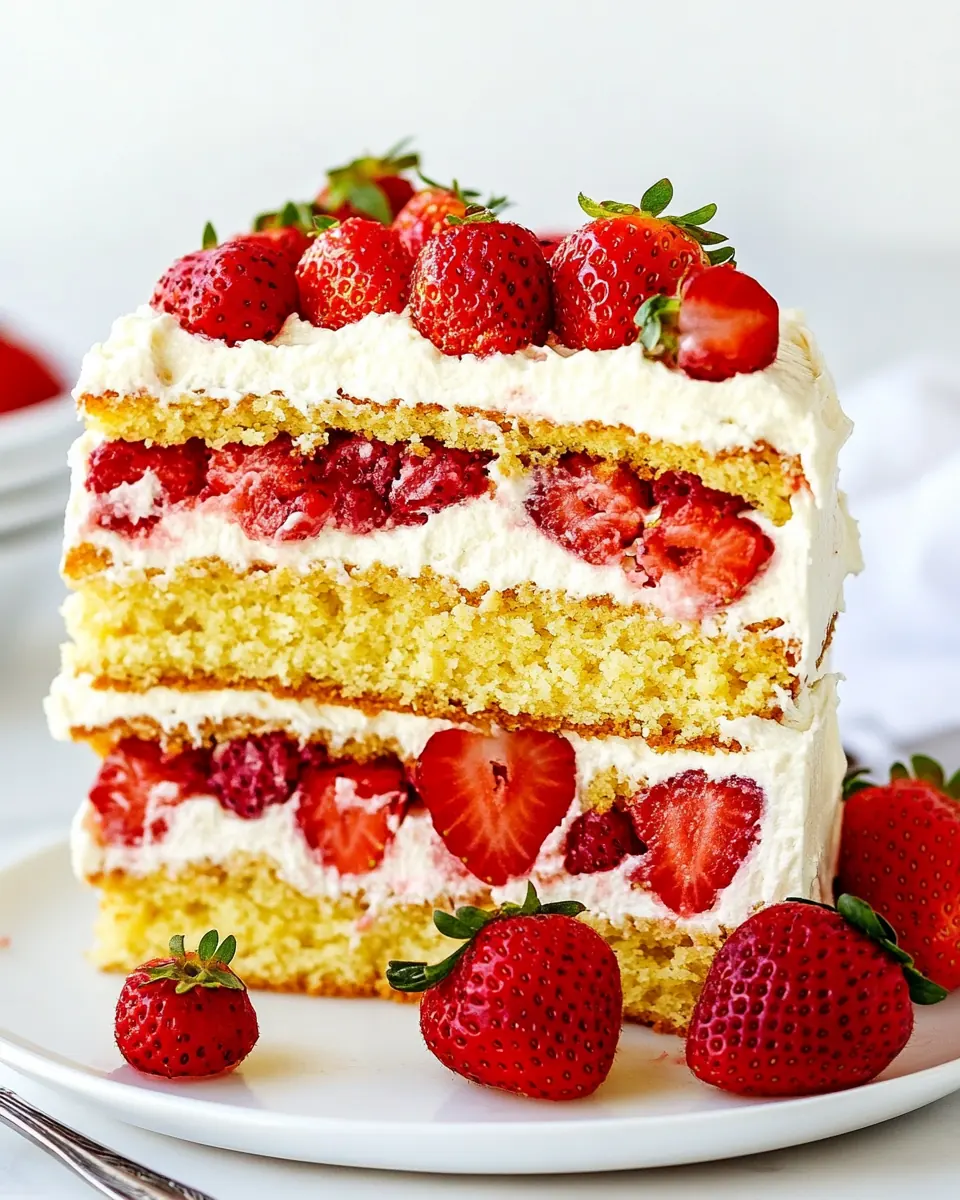
Cut cakes in half horizontally using a long-serrated knife to create 4 even layers (I score them first then cut along score lines). Add a dab of frosting to the center of a cake stand or platter 'to glue' bottom layer down. Add bottom layer of cake, cut side down, and arrange a ring of 18-20 strawberry halves, cut sides down and stem ends facing out, around perimeter of cake layer.: As you slice each cooled cake into halves, notice the clean crumb and how the knife moves through without tearing; scoring first gives a confident guide and prevents slippage. Anchoring the bottom layer with a dab of frosting prevents shifting during assembly and lets you build layers precisely. Placing 18 to 20 halved strawberries around the edge creates a beautiful border and promises a fruit filled bite near the rim. A common mistake is uneven layers that wobble; use a level hand and cool layers fully for best results.
Pour one third of processed berry mixture (about 3/4 cup) in center, then spread up to strawberries. Add 1 1/2 cups whipped cream over berry layer and spread to within 1/4” of the edge. Place second layer of cake on top, cut side down and press down gently so the whipped cream layer comes flush with cake edge. Repeat layers until you place the final cake layer, cut side down. Spread remaining whipped cream over top and decorate with remaining strawberries.: When you spoon the processed berry mixture into the cake center, you will see a glossy, ruby pool that smells intensely of fresh strawberries . Spreading the whipped cream to within a small margin keeps the layers tidy and prevents filling from oozing. Gently pressing each layer ensures contact and a cohesive slice while preserving air in the frosting. Repeat for remaining layers for a tall, impressive cake. Decorating the top with reserved halves adds a final bright note. Avoid overfilling, which leads to slippage and messy slices.
Chill at least 1 hour before serving. You can chill up to 8 hours, but it is best within the first 4.: Chilling firms the frosting and allows flavors to meld; during this time the cake settles and the syrup integrates with the crumb, which improves slice ability and mouthfeel. You'll notice the cake becomes less fragile after chilling and the whipped cream steadies. Serving too soon risks squashed layers, while very long chilling changes texture subtly and can dull freshness. For best results, plan assembly so you can chill for about 1 to 4 hours before cutting.